The right filament often decides whether a part holds or not. For figures and prototypes, standard PLA is enough. As soon as a part has to withstand heat, sun, impact or constant load, you need a different material. This overview helps you choose and names the typical pitfalls of each filament.
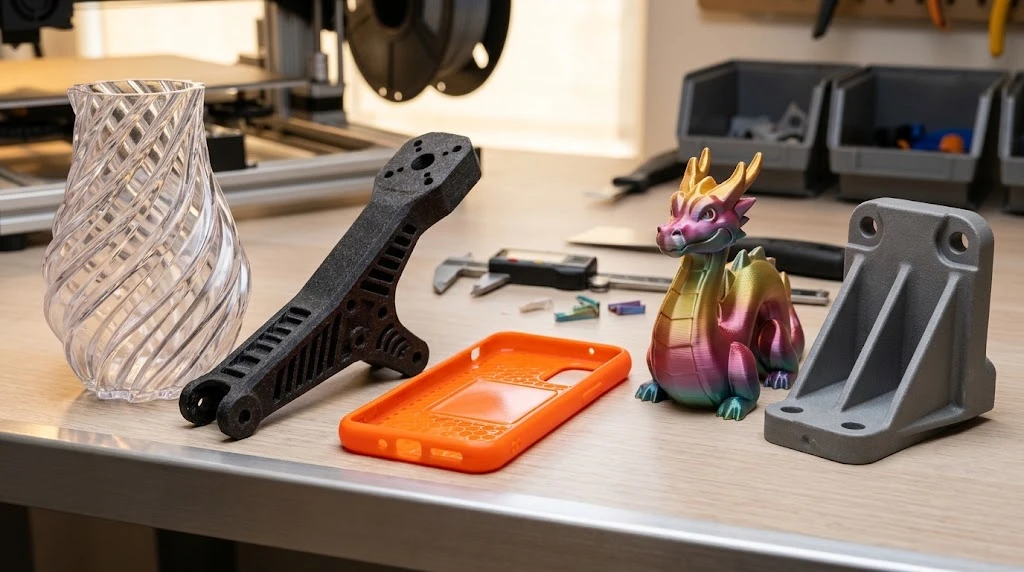
In 30 seconds
- Decoration, figures, prototypes, organizers: PLA. The easiest to print.
- Functional parts and brackets for indoors, containers: PETG.
- Parts in the car, in the sun or outdoors: ASA. ABS if weather does not matter much.
- Soft, elastic parts such as cases, seals, bumpers: TPU.
- Gears, hinges, heavily loaded parts: nylon (PA).
- Especially stiff, light parts: carbon-fibre reinforced variants, with a hardened nozzle.
The overview as a table
All materials at a glance. “Difficulty” says how easily the print succeeds, for price € means cheap and €€€ expensive, each relative to the others. The temperatures are rules of thumb.
| Material | Difficulty | Price | Nozzle / bed | Enclosure | Use |
|---|---|---|---|---|---|
| PLA | 🟢 Easy | € | 190–220 / 50–60 °C | No | Decoration, models, prototypes |
| PETG | 🟡 Medium | € | 225–250 / 70–85 °C | No | Functional parts, brackets, containers |
| ABS | 🟠 Demanding | € | 240–260 / 95–110 °C | Yes | Heat-resistant parts, utility objects |
| ASA | 🟠 Demanding | €€ | 240–260 / 95–110 °C | Yes | Outdoors, car, UV resistant |
| TPU | 🟡 Medium | €€ | 215–240 / 30–60 °C | No | Seals, cases, bumpers |
| Nylon (PA) | 🟠 Demanding | €€€ | 250–280 / 90–110 °C | Recommended | Gears, plain bearings, hinges |
| Polycarbonate (PC) | 🟠 Demanding | €€€ | 270–310 / 100–125 °C | Yes | Very impact and heat resistant |
| Carbon fibre variants | 🟠 Demanding | €€€ | as the base material | as the base material | Stiff, light parts, hardened nozzle needed |
Support materials such as PVA and HIPS are not listed here, they usually need a printer with two materials. Prices vary by manufacturer and offer.
The materials at a glance
All temperatures are rules of thumb. The manufacturer's figures on the spool take precedence.
PLA: the uncomplicated standard
- Rules of thumb: nozzle about 190 to 220 °C, bed about 50 to 60 °C. No enclosure needed.
- Strengths: Very easy to print, little warping, clean detail, low odour.
- Weaknesses: Heat resistant only to about 55 °C. A part in a car in the sun can deform. Unsuitable for outdoors and brittle under constant load.
- Choose it for: decoration, models, test fits, organizers, miniatures.
PETG: the all-rounder for functional parts
- Rules of thumb: nozzle about 225 to 250 °C, bed about 70 to 85 °C. No enclosure needed. Keep the part cooling fan moderate, about 20 to 50 percent, because too much cooling weakens layer adhesion. Heat resistant to about 70 to 75 °C.
- Strengths: Tougher and more impact resistant than PLA, good resistance to chemicals and moisture, usable UV resistance.
- Weaknesses: Prone to stringing, see Fix stringing. Absorbs moisture and sometimes sticks too strongly to smooth plates, where a thin coat of glue stick helps as a release agent.
- Choose it for: brackets, housings for indoor electronics, plant pots, hooks.
ABS and ASA: for heat and outdoor use
- Rules of thumb: nozzle about 240 to 260 °C, bed about 95 to 110 °C. An enclosure is mandatory. Heat resistant to about 95 to 100 °C.
- Strengths: Heat resistant, dimensionally stable, strong. ASA is additionally UV and weather resistant and does not fade as ABS does.
- Weaknesses: Prone to heavy warping and cracks, see Prevent warping. Fumes arise while printing, make sure there is ventilation or filtering.
- Choose it for: parts in the car interior, outdoor housings, garden adapters, drone frames.
TPU: for elastic parts
- Rules of thumb: nozzle about 215 to 240 °C, bed about 30 to 60 °C. No enclosure needed. Print very slowly, often 15 to 30 mm/s.
- Strengths: Elastic, wear resistant, dampens vibration. There are different hardnesses, 95A is usual for beginners, 85A and 70A are much softer.
- Weaknesses: Best with a direct drive extruder. In a Bowden system the soft material compresses in the tube, which only works slowly and with patience.
- Choose it for: phone cases, seals, tyres for RC models, furniture bumpers.
Nylon (PA): for load and wear
- Rules of thumb: nozzle about 250 to 280 °C, bed about 90 to 110 °C. An enclosure is recommended. Heat resistance depends strongly on the grade.
- Strengths: Tough, wear resistant, low friction.
- Weaknesses: Nylon absorbs moisture very strongly and must be dried thoroughly before printing. It tends to warp and usually needs an adhesion aid.
- Choose it for: gears, hinges, plain bearings, parts under high load.
Polycarbonate (PC): for extreme loads
- Rules of thumb: nozzle about 270 to 310 °C, bed about 100 to 125 °C. A heated, enclosed chamber is needed.
- Strengths: Very impact resistant and heat resistant, to about 110 to 130 °C.
- Weaknesses: Difficult to print. It needs a hotend that safely withstands these temperatures.
- Choose it for: machine guards and parts with very high requirements.
Fibre-reinforced filaments (for example PETG-CF, PLA-CF, PA-CF)
- Strengths: Added carbon fibres make the part much stiffer, reduce warping and give a matte surface.
- Weaknesses: The fibres are abrasive and wear out a standard brass nozzle in a short time. You need a hardened steel nozzle or one with a ruby tip. The same applies to glass fibre and glow-in-the-dark filaments.
- Choose it for: drone arms, stiff mounting plates, brackets with high stiffness requirements.
Important rules for all materials
- Drying is a must for PETG, TPU and nylon. Wet filament hisses at the nozzle, forms bubbles and gives brittle parts. Store it in a dry box before long prints and follow the manufacturer's drying temperature.
- Check the hotend: Hotends with PTFE lining are usually rated by the manufacturer only to about 240 to 260 °C. With ABS you are at the limit, and for nylon and PC you need a hotend without PTFE in the hot zone.
- Prepare the bed: Textured PEI plates work well for PLA and PETG. With PETG on smooth plates always use a release agent.
- Ventilation: Printing ABS, ASA and nylon produces fumes, print in a well ventilated room.
What does it cost?
The material makes up a large part of the cost of a print, and PLA and PETG are usually the cheapest. What a specific print costs you can work out in the print cost calculator: filament price, weight, power and scrap.
Further reading
- Fix stringing: fine strings, especially with PETG.
- Prevent warping: when corners lift, especially with ABS and ASA.
- Fix layer shifts: when layers slip.
- More tools in the directory
All values are rules of thumb and depend on printer, nozzle and filament. When in doubt, follow your manufacturer's specifications.